

AI ELD
Apr 9, 2026
In 2026, there is a fourth variable that most carriers did not see coming. FMCSA has removed more than 27 electronic logging devices from its registered devices list since January of this year, following 38 revocations across all of 2025. Carriers running any of those devices had 60 days to replace them or face out-of-service orders under 49 CFR 395.8(a)(1). That forced replacement wave is not free, and the fleets absorbing it are learning the hard way that the cheapest subscription price does not account for the cost of replacing hardware you thought would last longer.
This article covers the actual cost structure of ELD hardware installation, what you should and should not be paying for, and the one scenario where compatible hardware eliminates the installation cost entirely.
Every ELD installation falls into one of two categories based on how the device connects to the truck's engine control module.
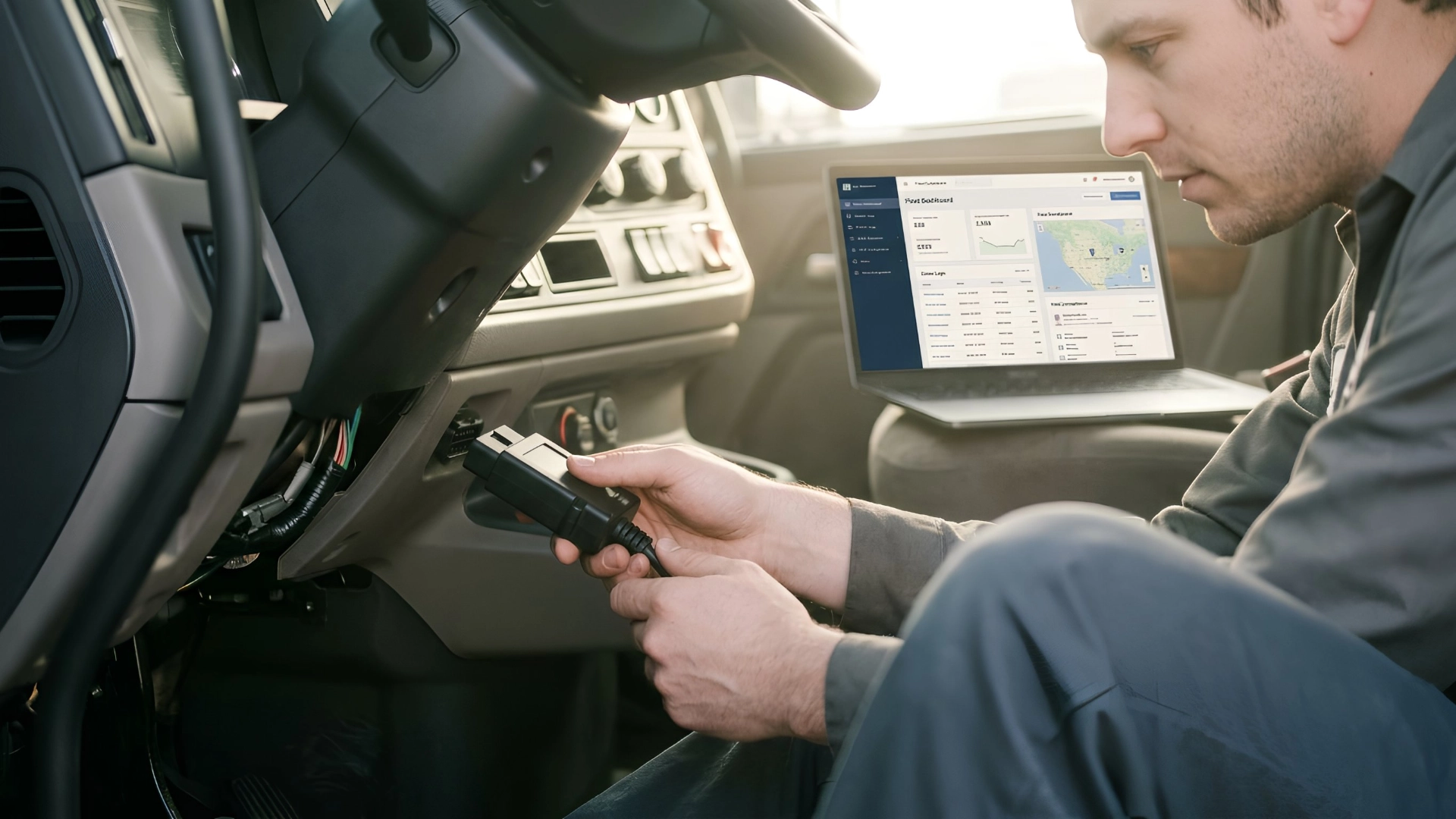
Plug-in devices connect directly to the truck's diagnostic port without tools. For heavy-duty trucks manufactured after 2000, that port is typically a 9-pin J1939 connector. Older commercial trucks often use a 6-pin J1708 connector. Light and medium-duty trucks use a standard OBD-II port. A plug-in device slides into the port, pairs with the driver's app via Bluetooth or USB, and is operational in under 15 minutes. There is no cable routing, no mounting hardware, and no tool requirement. The installation labor cost for a plug-in device is effectively zero. Any driver or fleet coordinator can do it.
Hardwired and cab-mounted devices are a different situation. Some ELD systems use a dedicated in-cab display that requires the device to be mounted on a bracket, wired to a power source, and routed cleanly through the cab. For those installations, labor costs across the market in 2026 run approximately $75 to $150 per truck for straightforward installs in a single metro area, rising to $225 to $350 per truck for complex configurations, rural locations, or specialized vehicle types. Based on GPS and ELD installation data compiled by Techsbook, a fleet of 25 trucks in two metro locations should budget $3,000 to $5,000 in installation labor alone, not including hardware or subscription costs.
The practical question for any fleet evaluating hardware is whether the device they are considering requires tools, mounting, or a technician, and whether that cost appears anywhere on the quote they received.
Understanding labor cost is only half of the installation equation. The device itself has a market rate, and knowing it prevents you from paying a markup that providers sometimes call a "compliance package" or "activation bundle."
For standard ELD devices in 2026, the reasonable market range for the hardware unit is up to approximately $150. Dash cameras, if included in the system, run up to approximately $270 for quality units. Prices above those levels for standard commercial hardware are almost always markups rather than meaningful technical differentiation.
The connector cable is where smaller costs add up. A 9-pin to J1939 cable, a 6-pin to J1708 adapter, or an OBD-II extension can each run $15 to $50 depending on length and quality. For a fleet with mixed vehicle types, confirming cable compatibility before ordering hardware avoids the situation where devices arrive on-site and a third of the fleet needs adapters that were not included.
Some providers offer what they describe as a "professional installation" for hardwired plug-in devices that do not actually require professional installation. A plug-in 9-pin device that connects in under 10 minutes does not need a $150 technician visit. If a provider's quote includes installation fees for a device that is designed to self-install, that is a charge worth pushing back on directly.
For a single truck, installation is simple. For a fleet of 15, 30, or 50 trucks, rollout logistics carry their own cost that rarely appears on any vendor quote.
Every truck needs to come off the road or be staged at a yard for the installation. Depending on the scale, that process runs in parallel or sequentially. Parallel staging requires coordinating multiple technicians and vehicles simultaneously. Sequential installation means individual trucks are unavailable for varying periods throughout the rollout. For a fleet running tight delivery schedules, even a one-hour installation window per truck translates to real revenue impact when multiplied across 30 vehicles.
The less visible cost is retraining. A new ELD system means drivers need to learn a different app interface, a different inspection mode workflow, and different log certification steps. Experienced drivers adapt quickly to well-designed systems, but every minute a driver spends confused at a weigh station because the inspection screen is unfamiliar has operational value.
This is the specific context where hardware compatibility with an existing device eliminates most of these costs entirely. If a carrier already has Pacific Track PT30 or PT40 units installed across their fleet, switching to AI ELD's supported hardware means the devices stay in the trucks. Drivers install a new app, receive new credentials, and are compliant on the new system without a single truck returning to the yard for hardware work. For a 20-truck fleet, that difference can be $3,000 to $7,000 in avoided labor and downtime depending on the installation complexity.
If you are currently evaluating a switch and want to know whether your existing hardware is compatible before committing to a timeline, the AI ELD team can confirm compatibility in a single conversation, typically within the same business day.
In 2025, FMCSA revoked 38 ELD devices. In the first months of 2026 alone, the agency removed at least 27 more. In February 2026, nine devices were revoked simultaneously with a 60-day deadline, followed by another wave in March. Carriers using any revoked device were required to replace them with compliant hardware from the registered devices list within 60 days or face out-of-service citations under 49 CFR 395.8(a)(1).
The practical cost of this for affected carriers included new hardware procurement, technician scheduling, driver downtime, and interim paper log requirements during the transition period. Carriers who had locked themselves into long-term contracts with providers whose hardware later appeared on the revocation list had no way to avoid that cost. The hardware investment they made when signing did not protect them from the replacement requirement.
FMCSA's stated reason for the revocations is consistent: devices failed to meet the minimum technical requirements established in Title 49 CFR Appendix A to Subpart B of Part 395. These are not fringe cases. Several of the revoked devices in 2026 were from providers with hundreds or thousands of units in service. For carriers who had prioritized the lowest device cost over the compliance track record of their provider, the revocation cycle created installation expenses that significantly exceeded whatever they originally saved.
The current registered ELD devices list should be verified for any device currently in use before signing any new contract, particularly for providers with minimal compliance history. Verifying registration status before a rollout is a five-minute check that can prevent a very expensive forced replacement.
For context on how the total ELD cost breakdown changes when you factor in hidden costs including revocation exposure, the existing cost article on this site covers that calculation in full.
Most fleet managers accept the first hardware quote without pushing back on the installation component. Several items are negotiable, and knowing which ones saves real money.
Professional installation for plug-in devices is the clearest place to push back. If the device connects via a standard 9-pin or OBD-II port without tools, a technician visit is unnecessary. Ask the provider directly whether the hardware is self-install. If yes, remove the installation line item from the quote.
Per-truck installation fees for a large fleet rollout are typically negotiable on volume. Providers who charge a flat per-truck fee for 5 trucks usually apply the same rate to 50 trucks without being asked. Batch scheduling improves technician efficiency, and that efficiency should be reflected in the price. Rates drop for large rollouts in most markets, but only if you ask.
Replacement hardware under warranty should be discussed at signing. If a device fails within a reasonable period, the replacement and any re-installation cost should be covered under warranty terms. A provider who cannot clearly state their hardware replacement policy is a provider whose contract terms deserve closer reading.
Installation cost is a one-time expense, but it is one that repeats every time a fleet changes providers. Carriers who have switched ELD providers twice in four years often find that the cumulative installation costs across both transitions exceed the annual savings from whichever subscription was cheaper.
The most effective way to reduce total installation cost is to choose hardware that is compatible with the system you are moving to, avoid providers with revocation risk, and confirm self-install eligibility before any technician is scheduled.
AI ELD's subscription plans start at $20 per truck per month with no long-term contract, and the system supports both Geometris WhereQube as a primary device and Pacific Track PT30 and PT40 for fleets with existing hardware. If you are looking at a hardware rollout and want to confirm compatibility, get a specific installation timeline, or understand what the full cost looks like for your fleet size, start a free 14-day trial and walk through the hardware options directly with the team before committing to any equipment purchase.
FMCSA. Multiple press releases: "FMCSA Removes Devices from List of Registered Electronic Logging Devices." December 2025 through March 2026. Source for revocation counts (38 in 2025, 27+ since January 2026), 60-day replacement window requirements, out-of-service criteria under 49 CFR 395.8(a)(1), and the requirement to revert to paper logs during the transition period. https://www.fmcsa.dot.gov/newsroom/fmcsa-removes-three-devices-list-registered-electronic-logging-devices https://eld.fmcsa.dot.gov/support/newsandevents
FreightWaves. "Revoked ELDs up 62% so far in 2025." December 2025. Source for the year-over-year increase in ELD revocations (34 in 2024 vs. 21 the prior year) and FMCSA's stated rationale around eliminating loopholes in the self-certification system. https://www.freightwaves.com/news/revoked-elds-up-62-so-far-in-2025
GetTransport Blog. "FMCSA Tightens ELD Registry, Dozens of Devices Removed." 2026. Source for the operational cost impact on carriers: replacement costs, labor for reinstallation, and short-term capacity constraints described as "material" for local and regional haulers. https://blog.gettransport.com/news/regulatory-action-27-elds-removed/
Techsbook. "2026 GPS Installation Cost Best Guide." January 2026. Source for hardwired ELD installation labor cost ranges ($225–$350 per commercial truck, $3,000–$5,000 for a 25-vehicle mixed fleet in two metro locations), and the breakdown of time-per-vehicle for first-time hardwired installs. https://techsbook.com/2026-gps-installation-cost/
FactorELD. "Choosing the Right ELD Cable: OBD-II, 6-Pin, or 9-Pin? 2025 Guide." Source for connector type descriptions: OBD-II for light/medium-duty, 6-pin J1708 for older commercial trucks, 9-pin J1939 for heavy-duty trucks manufactured after 2000. https://factoreld.com/choosing-eld-ca