

Apr 21, 2026
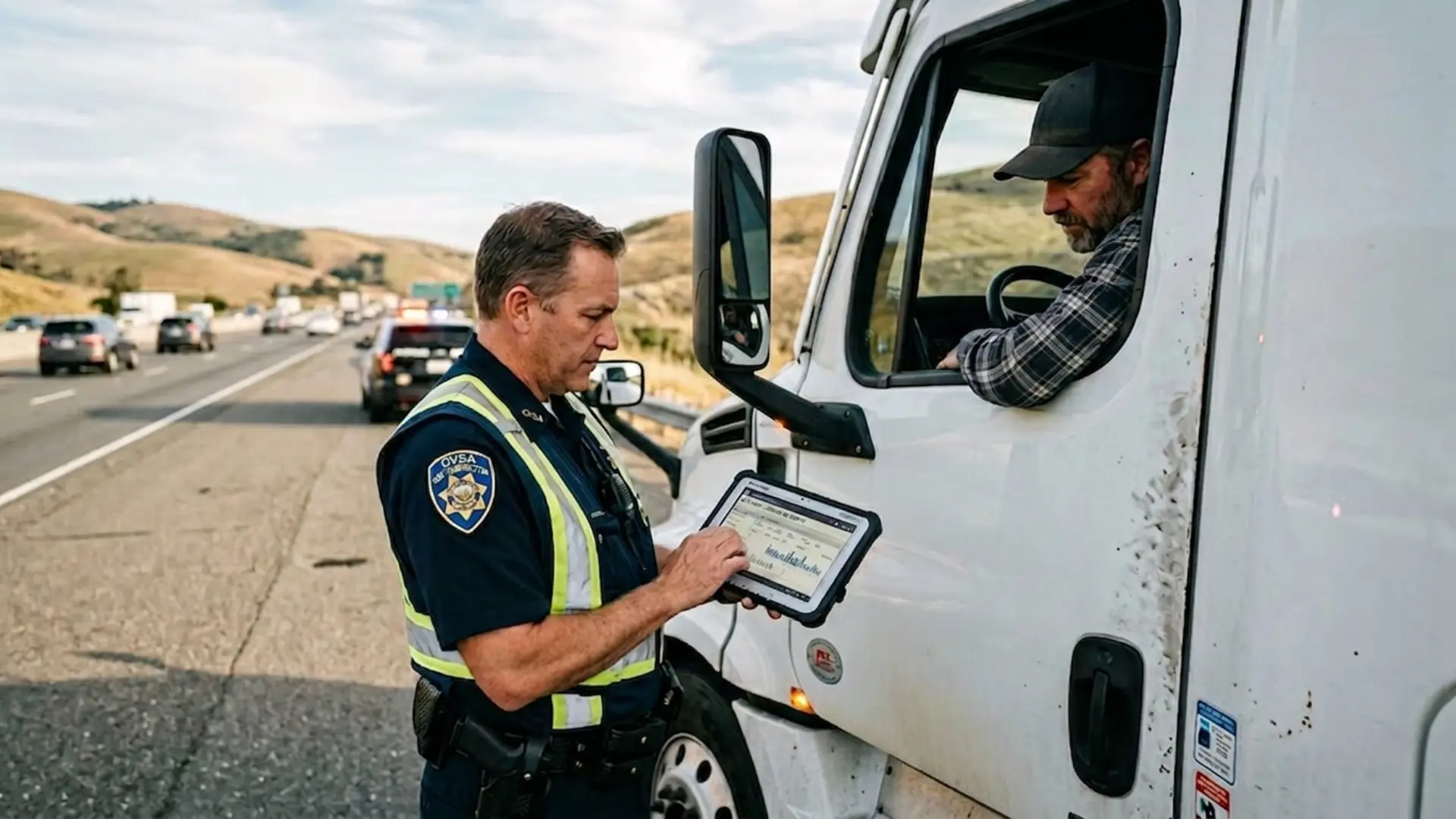
A loaded truck sitting on the shoulder of an interstate is not a compliance problem in the abstract. It is a missed delivery window, a shipper who needs an explanation, a driver who cannot continue, and a CSA score entry that stays visible to brokers and safety auditors for the next 24 months. An out-of-service order is the mechanism that puts the vehicle there, and it takes effect the moment an inspector issues it.
Understanding what triggers an ELD-related OOS order, how long the clock runs before the driver can legally resume, and what the fleet needs to do in the hours immediately after is not optional knowledge for a safety manager in 2026. The Commercial Vehicle Safety Alliance updated its North American Standard Out-of-Service Criteria effective April 1 of this year, adding a new OOS category specifically for ELD tampering. The May 12-14 International Roadcheck designated ELD tampering as the primary driver enforcement focus for the first time in the program's history. For fleets that have not examined their compliance posture against both changes, the window to do so before the largest enforcement event of the year is narrow.
ELD-related OOS orders fall into two mechanically distinct categories, and the recovery process differs depending on which one applies. Confusing them leads to incorrect expectations about how long a driver stays parked.
The first category is an HOS-exceeded OOS. When an inspector reviews the driver's logs and determines that the driver has already used up their available driving or on-duty time under 49 CFR Part 395, the driver cannot legally continue operating. The OOS order stays in effect until the driver has accumulated enough off-duty time to be eligible again under the applicable HOS ruleset. For a driver who has exhausted the 11-hour driving limit, that means a minimum of 10 consecutive hours off duty before the driving clock resets. For a driver in a 14-hour window violation, the same 10-hour off-duty requirement applies. The relevant HOS rules and how each limit works are covered in the complete guide to HOS rules for truck drivers.
The second category, which became significantly more consequential as of April 1, 2026, is an ELD tampering OOS. This applies when an inspector finds evidence that the records of duty status have been reengineered, reprogrammed, or otherwise manipulated, and the ELD does not accurately record or retain the required data. The defining characteristic of a tampering OOS is that the inspector cannot determine when actual driving or rest periods occurred because the alterations have made the entire record unreliable. In those cases, under the new CVSA 2026 criteria, the driver receives an automatic 10-hour off-duty OOS order regardless of what the displayed logs show.
The legal citation for a traditional false-log violation is 49 CFR 395.8(e)(1). The citation for an ELD tampering violation, which became a separately enumerated category this year, is 49 CFR 395.8(e)(2). These are different regulatory citations, different entries in the inspection report, and carry different enforcement implications.
There is also a non-OOS outcome worth understanding because it affects the fleet even when the driver continues. When an inspector identifies a false-log violation but can determine when the actual rest occurred and the driver is not currently over hours, the driver receives a citation under 395.8(e)(1) and is allowed to proceed. The citation still enters the CSA system and affects the carrier's Hours-of-Service Compliance BASIC score. It does not park the truck that day, but it is not a clean inspection either.
The April 1, 2026 update to the CVSA North American Standard Out-of-Service Criteria introduced a new OOS condition that did not previously exist: Part I, Item 10, Driver's Record of Duty Status, Property-Carrying Vehicles (8). Under this addition, a driver or motor carrier who tampers with an electronic logging device in a way that makes it impossible to determine what events have occurred is subject to an immediate OOS order.
CVSA Inspection Bulletin 2026-02, titled "False Records of Duty Status and Electronic Logging Device Tampering," was published on March 2, 2026, ahead of the April 1 effective date. The bulletin explains precisely what inspectors are encountering in the field: records of duty status that have been altered by days, not hours, with no indication in the ELD's event log that any changes were made. The only way inspectors identify these alterations is by comparing supporting documents, such as fuel receipts, toll records, and scale tickets, against the ELD record. When a fuel receipt places the driver in Missouri on a Tuesday and the ELD shows the driver off-duty in Arizona on that same date, the gap is not explainable as a log error. It is a fabricated record.
In the example cited in the bulletin, inspectors found a record that had been shifted back by three days, covering more than 1,300 miles of driving that appeared nowhere in the ELD data. CVSA Roadside Inspection Specialist Jeremy Disbrow described the enforcement rationale for the automatic 10-hour OOS in those situations directly: when the entire record is a work of fiction, there is no reliable information about when the driver last rested. The only defensible response is to treat the driver as needing a full reset.
The bulletin also addresses fictitious driver accounts. Carriers discovered creating alternate ELD accounts under slightly modified versions of a driver's credentials, then alternating between accounts to continue operating after HOS limits are reached, fall under the same tampering category. Inspectors are instructed to document verification efforts in the inspection notes and to contact the motor carrier to support the violation finding.
For an HOS-exceeded OOS, the duration is determined by what the driver needs to regain eligibility. The most common scenario is a driver who has exceeded the 11-hour driving limit or the 14-hour window. The clock starts running from the time the officer issues the OOS order, and the driver must log the required off-duty or sleeper berth time before they can operate again. For a standard 10-hour off-duty reset, that means the truck sits for at least 10 hours from the point the order is issued.
For the new ELD-tampering OOS, the criteria specify 10 consecutive hours off duty from the time of the OOS order, regardless of what the manipulated logs might suggest about prior rest.
During the OOS period, the driver cannot operate the vehicle at all. They can remain in the sleeper berth and log sleeper time, which counts toward the reset requirement. They cannot move the truck, even to relocate it to a safer rest area, without the OOS being lifted by a certified enforcement officer. In practice, drivers contact the fleet immediately after an OOS is issued, and the fleet coordinates with the enforcement officer about conditions for release.
The OOS order itself is recorded in the FMCSA Motor Carrier Management Information System and becomes part of the carrier's publicly visible inspection history on the SAFER database. Brokers and shippers routinely check carrier OOS rates before tendering freight. A single OOS order does not necessarily disqualify a carrier from freight opportunities, but a pattern of OOS orders within a 24-month inspection window raises flags that are difficult to explain away.
If your fleet is currently managing driver logbook compliance across multiple vehicles and you are not consistently reviewing logs for unassigned driving events, uncertified records, and approaching HOS limits before each driver's shift begins, the time to build that workflow is before the inspection, not after. The AI ELD fleet compliance dashboard surfaces open compliance issues fleet-wide so safety managers can catch them before they become inspection findings.
The first 30 minutes after an OOS order determine whether the situation stays manageable or compounds. Most fleets that handle OOS situations well have a response sequence that starts with a single phone call.
The driver contacts the fleet the moment the OOS order is issued. The safety coordinator confirms the citation details: which regulation, what the officer determined, whether it is an HOS-exceeded order or an ELD-related citation, and what time the OOS clock began. That information determines when the driver can legally resume, what documentation the fleet needs to gather, and whether the shipper or broker needs to be notified about the delivery timeline.
The fleet then pulls the driver's log history from the ELD platform. For an HOS-exceeded OOS, the log review determines whether the violation was a scheduling error, a dispatcher miscalculation, or a driver error in duty status recording. For an ELD-related citation, the log review identifies whether the carrier has a system management problem, a device issue, or a compliance program gap. The automated compliance reports in a well-built ELD system allow the safety coordinator to pull the relevant log data quickly and begin the internal review without waiting for the driver to return to the terminal.
For the shipper or broker, an honest explanation delivered promptly is significantly better than a delayed explanation delivered under pressure. Most shippers have contingency protocols for delivery delays. What they do not have tolerance for is being informed of a delay after the fact, without explanation.
The OOS order remains on the carrier's inspection record for 24 months. If the fleet believes the order was issued in error, the DataQs system at the FMCSA allows carriers to challenge inspection findings. A successful DataQ challenge can remove or amend an incorrect entry. Carriers have 24 months from the date of the inspection to file. The challenge must include documentation supporting the contention that the inspection finding was inaccurate.
The CVSA International Roadcheck runs May 12-14, 2026. During those 72 hours, enforcement personnel across the United States, Canada, and Mexico conduct an average of 15 inspections per minute. The 2026 driver focus is ELD tampering, falsification, and manipulation. This is the first time in the Roadcheck program's history that ELD compliance is the primary driver inspection theme.
During the 2025 International Roadcheck, 10% of all driver OOS orders were the result of falsified records of duty status. HOS-related violations have historically accounted for more than 30% of all driver OOS orders across the program's history. Historically, approximately 81-94% of drivers pass Roadcheck inspections without an OOS order. The drivers who do not are disproportionately those with unresolved log issues, unassigned driving events, or devices that cannot produce clean records on demand.
For fleets that receive monitoring through AI ELD, the monitoring team watches for disconnected devices, unassigned driving segments, and approaching HOS limits in real time, covering the overnight periods when no one in the office is watching the dashboard. For fleets that are not currently using monitoring, reviewing the ELD monitoring service included in the Monitoring plan before May 12 is worth calculating against the cost of a single OOS order.
The enforcement timeline for revoked ELD deadlines also intersects directly with Roadcheck. The devices revoked in February 2026 entered OOS territory on April 14. The devices revoked in March 2026 follow on May 4, which is eight days before Roadcheck begins. Any carrier still running a revoked device on May 12 is already operating in violation of 395.8(a)(1) and faces an automatic OOS order the moment an inspector confirms the device.
The clearest thing a fleet can do before May 12 is run through its last 30 days of logs and confirm that every driver has certified their records, that unassigned driving events have been reviewed and resolved, that no devices on the revoked list are still installed, and that the duty status recorded in the ELD matches what the driver's supporting documents would show if an inspector compared them.
None of this requires a compliance overhaul. It requires a systematic review that a good ELD platform makes possible in under an hour per fleet. The carriers who emerge from Roadcheck with clean inspections are not operating differently from the carriers who do not. They are operating with better visibility into their own logs before an inspector gets to see them.
If you want to understand what that visibility looks like across your specific fleet before Roadcheck begins, start a free 14-day trial of AI ELD. The dashboard shows every driver's current HOS status, open unassigned events, uncertified logs, and device connection status in a single view. Running that review now costs nothing. Running it after a Roadcheck OOS order costs considerably more.
CVSA. "CVSA's 2026 Out-of-Service Criteria Now in Effect." April 1, 2026. Primary source for the new OOS condition under Part I, Item 10, Property-Carrying Vehicles (8) for ELD tampering making it impossible to determine driver events. Confirms all 17 changes take effect April 1 and supersede all previous versions. https://cvsa.org/news/2026-oosc/
CVSA. Inspection Bulletin 2026-02: "False Records of Duty Status and Electronic Logging Device Tampering." March 2, 2026. Primary source for inspector guidance on how to distinguish traditional false-log violations (49 CFR 395.8(e)(1)) from ELD tampering violations (49 CFR 395.8(e)(2)), including the automatic 10-hour OOS for cases where drive and rest periods cannot be determined. https://cvsa.org/wp-content/uploads/2026-02-Inspection-Bulletin.pdf
Overdrive Online. "ELD Tampering Officially an Out-of-Service Violation." April 1, 2026. Source confirming the new OOS criteria took effect, differentiating between traditional false-log violations and ELD tampering violations, with the determining factor being whether the inspector can determine when actual drive and rest periods occurred. https://www.overdriveonline.com/electronic-logging-devices/article/15821159/eld-tampering-officially-an-outofservice-violation
Transport Topics. "CVSA to Enforce New ELD Tampering Out-of-Service Rule April 1." March 2026. Source for CVSA Roadside Inspection Specialist Jeremy Disbrow's explanation of the 10-hour automatic OOS rationale, the prevalence of noncompliant ELDs designed to allow data manipulation, and the May 12-14 International Roadcheck focus on ELD tampering. https://www.ttnews.com/articles/cvsa-eld-tampering-rule
FreightWaves. "CVSA Approves 17 Changes to 2026 Out-of-Service Criteria." February 15, 2026. Source for the CVSA approval process: 51 of 70 Class I jurisdictions voted, 17 changes approved, all effective April 1, 2026. https://www.freightwaves.com/news/cvsa-approves-17-changes-to-2026-out-of-service-criteria-what-small-carriers-need-to-know-before-april-1
Trucksafe. "2026 CVSA International Roadcheck: ELD Tampering Focus and Prep Guide." Source for 2025 Roadcheck data: 56,178 inspections conducted, 10% of driver OOS violations were falsified logs. Source for HOS violations accounting for more than 30% of driver OOS orders historically and for fine ranges: operating without ELD $1,000-$3,000, falsifying records $3,000-$10,000. https://trucksafe.com/post/cvsa-2026-international-roadcheck-eld-tampering-preparation-guide
Tank Transport Trader. "Roadcheck ELD Enforcement: 12 Major Enforcement Risks for Fleets in 2026." Source for the enforcement timeline: April 14 (February revoked-device batch becomes OOS), May 4 (March batch becomes OOS), May 12-14 (International Roadcheck). https://tanktransport.com/2026/04/roadcheck-eld-enforcement/