

AI ELD
Feb 24, 2026
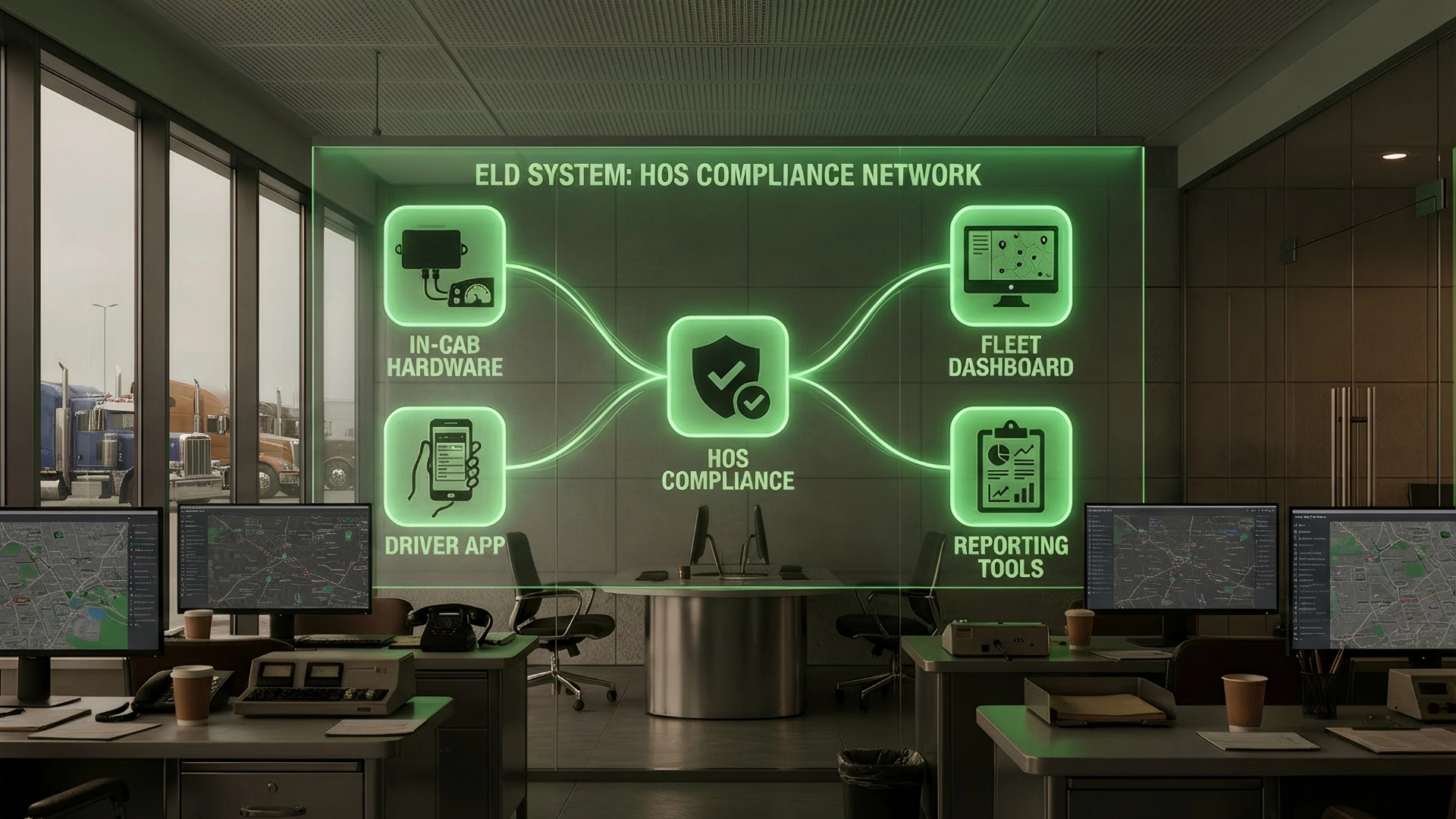
An ELD system for trucks is not one device plugged into a port. That framing is where most confusion about compliance actually starts, because a carrier who thinks of the ELD as a single piece of hardware evaluates it like one, checks whether it is installed, assumes the job is done, and misses that the hardware is only the first of several parts that all have to function correctly together. Hours-of-service compliance, roadside inspection readiness, audit documentation, and fleet-wide visibility all depend on how the complete system performs, not just whether a device is bolted into the dashboard.
If you are looking for exactly this kind of system already built and running rather than reading about the pieces in the abstract, AI ELD is worth checking out directly.
A complete ELD system for trucks has five main parts, and together they form the operational structure that produces automated logging, compliance monitoring, and fleet visibility. This structure is not specific to one vendor. It is widely referenced across the industry because it reflects how ELD platforms are actually designed, implemented, and evaluated in real fleet environments, and understanding each part separately is what lets a fleet manager evaluate a system properly instead of just confirming a device is present.
The in-cab device is the physical unit installed in the vehicle, either through a plug-in connection to the diagnostic port or a hardwired install. This is the part most people picture when they hear "ELD," but it is also the part with the strictest technical requirement behind it, and that requirement is worth stating precisely rather than loosely. Under the federal technical specification at 49 CFR Appendix A to Subpart B of Part 395, the device must be integrally synchronized with the vehicle's engine to automatically capture four specific data points: engine power status, vehicle motion status, miles driven, and engine hours. This is the requirement that separates a genuine ELD from a GPS tracker or a standalone logging app, both of which can display similar information but cannot pull it directly from the engine control module the way a compliant device must. The difference between an ELD and a GPS tracker covers exactly why that engine connection is non-negotiable and what a device that lacks it cannot legally do.
The driver mobile application is the interface a driver interacts with directly, confirming duty status, reviewing remaining hours, and presenting records at a roadside inspection. The app receives data from the in-cab device in real time and translates it into something a driver can act on without needing to understand the underlying engine data. A well-built driver app keeps duty status changes to two or three taps and makes the inspection screen reachable without digging through menus, because the quality of this interface determines how much clean data the system actually produces day to day. The logbook and log management tools that power this interface are covered in full detail separately, including exactly what gets recorded and how duty status transitions work.
The web-based fleet dashboard is where dispatch and safety teams see the same data the driver app surfaces, but aggregated across every vehicle rather than one truck at a time. This is the component that turns individual compliance records into fleet-wide visibility: which drivers are approaching an hours limit, which vehicles have generated unassigned driving events, which devices have disconnected. A dashboard that requires reviewing logs one driver at a time is not built for fleet management, it is a driver app with extra steps. The fleet compliance dashboard is the component most directly responsible for whether a safety coordinator can actually manage compliance proactively rather than discovering problems after the fact.
Reporting tools generate the structured outputs a fleet needs for inspections, audits, and internal review: hours-of-service violation summaries, unassigned driving reports, state-by-state mileage for fuel tax filing, and formatted exports suitable for a compliance review. This component is frequently underestimated during evaluation, because a system can record data accurately and still fail a fleet if that data cannot be pulled into a usable report on demand. The compliance reports a system generates are often the actual deciding factor in how much administrative time a fleet spends on compliance-related tasks, since automated, exportable reports remove the manual reconstruction work a thinner system leaves behind.
Backend infrastructure and support is the least visible part and the one most carriers only think about when something breaks. This covers the servers that store and retain records for the federally required period, the update process that keeps the device compliant as regulations shift, and the human support available when a driver or coordinator hits a problem the software alone cannot solve. A system with excellent hardware and a thin support operation behind it is a system that fails exactly when it matters most, at a roadside stop or during an audit request.
The industry casually uses ELD to mean the physical hardware, and that shorthand causes real evaluation mistakes. A carrier comparing two options purely on hardware specs, chip quality, mounting style, is comparing the least differentiated part of the whole system. The device has to meet the federal technical standard or it is not legal, full stop, but meeting that standard is a floor every registered device already clears. What actually varies between providers, and what determines whether the system works well for a specific fleet, is almost entirely in the other four components: how usable the driver app is under real conditions, how much visibility the dashboard actually gives a safety coordinator, how complete the reporting is, and how reliable the support is when something goes wrong.
This is the same distinction that matters when evaluating a logbook specifically. An electronic logbook is the driver-facing piece of the system, and whether it functions as a compliant record depends entirely on its connection to the engine-synchronized hardware behind it, not on the app alone. The full explanation of what an electronic logbook actually records covers this same principle from the logbook's specific angle, and it is worth reading alongside this article for the complete picture of how the pieces connect.
It is worth separating clearly what the federal mandate specifies from what is left entirely to the provider's design choices, because conflating the two leads to either overconfidence or unnecessary confusion during evaluation.
The mandate specifies the technical output: the four ECM-derived data points already covered, the format logs must be presented in, the retention period, and the transfer methods a device must support at a roadside inspection. It does not specify how usable the driver app has to be, how the dashboard should be organized, what reports beyond the required minimum should exist, or how good support has to be. Every registered device on the FMCSA list has cleared the technical floor. The experience built on top of that floor is entirely a design and business decision made by the provider, which is exactly why two FMCSA-compliant systems can produce very different day-to-day outcomes for the fleet running them.
One detail worth knowing specifically, because it surprises fleet managers who assume more precision than the rule actually requires: location data captured by the system is intentionally limited to roughly a one-mile radius during normal driving status, dropping to roughly ten miles during personal conveyance, by design, to give drivers a measure of privacy while still satisfying the requirement to record approximate location at each duty status change. A system is not under-delivering if it does not show pinpoint GPS accuracy in the compliance log. That imprecision is the regulation working as intended, not a system limitation.
The practical takeaway for anyone selecting or reviewing an ELD system is to evaluate all five parts, not just the one that is easiest to compare on a spec sheet. Confirm the hardware meets the technical standard and appears on the current FMCSA registered list, since that part is non-negotiable. Then spend the real evaluation time on the driver app's usability, the dashboard's actual visibility into fleet-wide compliance, the completeness of the reporting tools against what a compliance review or audit will actually ask for, and the responsiveness of support when something breaks outside business hours.
A fleet that evaluates only the device and assumes the rest follows automatically is the fleet most likely to discover, months into using a system, that the reports it needs do not exist, the dashboard cannot answer the questions a safety coordinator actually has, or the support line does not answer when a driver is stuck at a weigh station. The device is the part of the system every compliant option already has in common. The other four parts are where the real evaluation happens.
If you want to see how these five parts work together in a system built specifically to hold up under real fleet conditions rather than just the technical minimum, start a free 14-day trial and run it against your own trucks and drivers before deciding anything.
eCFR. "49 CFR Appendix A to Subpart B of Part 395: Electronic Logging Devices." Primary regulatory source for the technical specification requiring integral engine synchronization and the four data points a compliant device must automatically capture: engine power status, vehicle motion status, miles driven, and engine hours. https://www.ecfr.gov/current/title-49/subtitle-B/chapter-III/subchapter-B/part-395
FMCSA. "ELD Functions." Primary regulatory source for the location data accuracy specification, approximately one-mile radius during normal driving status and approximately ten-mile radius during personal conveyance, established to provide driver privacy while satisfying the geo-location recording requirement. https://www.fmcsa.dot.gov/hours-service/elds/eld-functions
FMCSA. "Electronic Logging Devices." Primary regulatory source for the registered device list, the retention period requirement, and the data transfer methods a compliant system must support at a roadside inspection. https://www.fmcsa.dot.gov/hours-service/elds/electronic-logging-devices
AI ELD. "ELD vs GPS Tracker: Why Location Data Alone Does Not Satisfy FMCSA Compliance." Source for the full technical explanation of why engine synchronization, not GPS alone, is the requirement that defines a compliant in-cab device. https://ai-eld.com/insights/eld-vs-gps-tracker
AI ELD. "Electronic Logbook for Truckers: What It Actually Records, and What Most Explanations Leave Out." Source for the complete explanation of the driver-facing logbook component specifically, including what it records and how it depends on the hardware behind it. https://ai-eld.com/insights/electronic-logbook-for-truckers